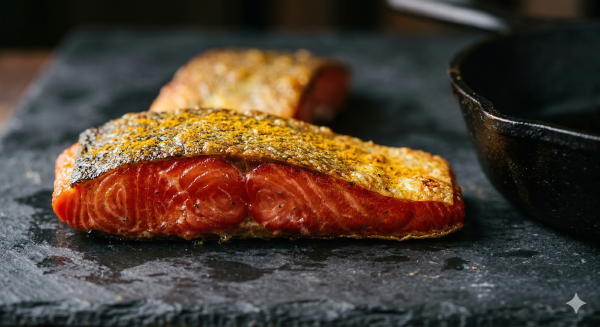
This is the cast iron wild salmon with a second gear. The base technique is the same — screaming-hot cast iron, skin side down — but a white miso glaze goes on top before finishing under the broiler. The miso caramelizes in about 90 seconds under direct heat, creating a savory crust that adds umami, probiotics, and manganese without meaningful calories. Bok choy halves go into the same skillet, cut-side down, and char while the salmon sears. One pan, ten minutes, 320 calories, 36g protein.
The bok choy is not decorative. It contributes 120mg of bioavailable calcium per serving — unlike spinach, bok choy is ultra-low in oxalates, so your body absorbs most of the calcium it contains. Paired with the salmon’s 500 IU of vitamin D, this is a calcium-plus-D delivery system at negligible caloric cost.
Ingredients
- 5 oz wild-caught salmon fillet (sockeye or coho), skin on
- 2 heads baby bok choy, halved lengthwise
- 1 tbsp white miso paste
- 1 tsp rice vinegar
- 1/2 tsp garlic powder
- 1/4 tsp black pepper
- 1/2 tsp coconut oil
Gold users: Paste this page's URL into Cronometer's Recipe Importer to auto-import with full nutrition data.
Free users: Copy or download the ingredient list below, then paste into Add Food > Create Recipe > Paste Ingredients.
5 oz wild-caught salmon fillet (sockeye or coho), skin on
2 heads baby bok choy, halved lengthwise
1 tbsp white miso paste
1 tsp rice vinegar
1/2 tsp garlic powder
1/4 tsp black pepper
1/2 tsp coconut oil
Instructions
- Set your oven rack 6 inches from the broiler element. Turn the broiler to high.
- Mix white miso, rice vinegar, and garlic powder in a small bowl until smooth. This is the glaze.
- Remove salmon from the fridge 10 minutes before cooking. Pat the fillet completely dry — both sides. Season the flesh side with black pepper.
- Heat your cast iron skillet over high heat until the surface is around 450°F. Add coconut oil.
- Place the bok choy halves cut-side down in the skillet, pressing gently. Sear for 2 minutes until the cut faces are charred and golden. Move them to the edges of the skillet.
- Place the salmon skin side down in the center of the skillet. Press gently with a spatula for the first 10 seconds to ensure full skin-to-pan contact. Sear for 4 minutes without touching it.
- Spoon the miso glaze over the top and sides of the salmon. Do not flip the fish.
- Transfer the skillet directly under the broiler. Broil for 2-3 minutes. The miso glaze will bubble, then caramelize to a deep golden brown. Watch it closely — miso burns fast once it passes the caramelization point.
- Remove immediately. The salmon should be slightly translucent in the center — carryover heat finishes it. The bok choy stems should be tender-crisp, not collapsed.
CRON Notes
Astaxanthin plus miso fermentation. The salmon provides astaxanthin — the most potent dietary carotenoid, mitochondrial-protective, fat-soluble, and exclusive to wild-caught fish. The miso glaze adds Aspergillus oryzae fermentation byproducts including bioactive peptides and isoflavones. Broiling partially preserves the probiotic cultures because the interior of the glaze stays below lethal temperature while the surface caramelizes.
Calcium absorption without oxalates. Bok choy delivers calcium with an absorption rate of approximately 54%, compared to roughly 5% for spinach. The vitamin D from the salmon (500 IU, roughly 83% of the daily value) enhances intestinal calcium absorption. This is why this pairing works better than either food alone.
Selenium load. A single serving provides 44 mcg of selenium — approximately 80% of the daily value. Selenium is the rate-limiting cofactor for glutathione peroxidase, the primary endogenous antioxidant enzyme. Combined with the omega-3 fatty acids (EPA and DHA) in wild salmon, this is a concentrated anti-inflammatory plate.
This pairs well with the wakame miso cream drizzled over the bok choy, or the ginger scallion sauce if you want brightness. The miso-glazed bok choy and shiitake side works if you want to scale the vegetable portion for batch prep.
One-page PDF. Print it, stick it on the fridge, fill it in each week.
New and seasonal recipes, and what's working. Once a month. No ads, no fluff.